| Source (List) |
Event |
Time Before Present
(Years) |
Time to Next Event
(Years) |
|
Carl Sagan |
Big Bang |
15000000000 |
5000000000 |
|
Carl Sagan |
Origin of Milky Way Galaxy |
10000000000 |
5400000000 |
|
Carl Sagan |
Origin of the Solar System |
4600000000 |
200000000 |
|
Carl Sagan |
Formation of the Earth |
4400000000 |
400000000 |
|
Carl Sagan |
Origin of life on Earth |
4000000000 |
300000000 |
|
Carl Sagan |
Formation of the oldest rocks known on
Earth |
3700000000 |
300000000 |
|
Carl Sagan |
Date of oldest fossils (bacteria and
blue-green algae) |
3400000000 |
900000000 |
|
Carl Sagan |
Invention of sex (by microorganisms) |
2500000000 |
500000000 |
|
Carl Sagan |
Oldest fossil photosynthetic plants |
2000000000 |
100000000 |
|
Carl Sagan |
Eukaryotes (first cells with nuclei)
flourish |
1900000000 |
700000000 |
|
Carl Sagan |
Significant oxygen atmosphere begins
to develop on Earth |
1200000000 |
200000000 |
|
Carl Sagan |
Extensive volcanism and channel formation
on Mars |
1000000000 |
380000000 |
|
Carl Sagan |
First worms |
620000000 |
50000000 |
|
Carl Sagan |
Precambrian ends. Paleozoic Era and Cambrian
Period begin. Invertebrates flourish |
570000000 |
40000000 |
|
Carl Sagan |
First oceanic plankton. Trilobites flourish. |
530000000 |
40000000 |
|
Carl Sagan |
Ordovician Period. First fish, first
vertebrates. |
490000000 |
40000000 |
|
Carl Sagan |
Silurian Period. First vascular plants.
Plants begin colonization of land |
450000000 |
40000000 |
|
Carl Sagan |
Devonian Period begins. First insects.
Animals begin colonization of land |
410000000 |
40000000 |
|
Carl Sagan |
First amphibians. First winged insects. |
370000000 |
40000000 |
|
Carl Sagan |
Carboniferous Period. First trees. First
reptiles. |
330000000 |
40000000 |
|
Carl Sagan |
Permian Period begins. First dinosaurs. |
290000000 |
40000000 |
|
Carl Sagan |
Paleozoic Era ends. Mesozoic Era Begins. |
250000000 |
40000000 |
|
Carl Sagan |
Triassic Period. First mammals. |
210000000 |
50000000 |
|
Carl Sagan |
Jurassic Period. First birds. |
160000000 |
40000000 |
|
Carl Sagan |
Cretaceous Period. First flowers. Dinosaurs
become extinct. |
120000000 |
38000000 |
|
Carl Sagan |
Mesozoic Era ends. Cenozoic Era Tertiary
Period begins. First cetaceans. First primates. |
82000000 |
41000000 |
|
Carl Sagan |
First evolution of frontal lobes in the
brain of primates. First hominids. Giant mammals flourish. |
41000000 |
23000000 |
|
Carl Sagan |
Origin of Proconsul and Ramapithecus,
probable ancestors of apes and men |
18000000 |
15400000 |
|
Carl Sagan |
First humans |
2600000 |
900000 |
|
Carl Sagan |
Widespread use of stone tools |
1700000 |
1290000 |
|
Carl Sagan |
Domestication of fire by Peking man |
410000 |
290000 |
|
Carl Sagan |
Beginning of most recent glacial period |
120000 |
62000 |
|
Carl Sagan |
Seafarers settle Australia |
58000 |
29000 |
|
Carl Sagan |
Extensive cave painting in Europe |
29000 |
10000 |
|
Carl Sagan |
Invention of agriculture |
19000 |
7000 |
|
Carl Sagan |
Neolithic civilization; first cities |
12000 |
7200 |
|
Carl Sagan |
First dynasties in Summer, Ebla, and
Egypt; development of astronomy |
4800 |
500 |
|
Carl Sagan |
Invention of the alphabet; Akkadian Empire |
4300 |
500 |
|
Carl Sagan |
Hammurabic legal codes in Babylon; Middle
Kingdom in Egypt |
3800 |
400 |
|
Carl Sagan |
Bronze metallurgy; Mycenaean culture;
Trojan War; Olmec culture; invention of the compass |
3400 |
500 |
|
Carl Sagan |
Iron metallurgy; First Assyrian Empire;
Kingdom of Israel; founding of Carthage by Phoenicia |
2900 |
500 |
|
Carl Sagan |
Asokan India; Ch'in Dynasty China; Periclean
Athens; birth of Buddha |
2400 |
500 |
|
Carl Sagan |
Euclidian geometry; Archimedean physics;
Ptolemaic astronomy; Roman Empire; Christ |
1900 |
500 |
|
Carl Sagan |
Zero and decimals invented in Indian
arithmetic; Rome falls; Moslem conquests |
1400 |
400 |
|
Carl Sagan |
Mayan civilization; Sung Dynasty China;
Byzantine empire; Mongol invasion; crusades |
1000 |
500 |
|
Carl Sagan |
Renaissance in Europe; voyages of discovery
from Europe and from Ming Dynasty China; emergence of the
experimental method in science |
500 |
499 |
|
Carl Sagan |
Widespread development of science and
technology; emergence of global culture; acquisition of the
means of self-destruction of the human species; first steps
in space craft planetary exploration and the search of extraterrestrial
intelligence |
1 |
|
|
American Museum of Natural History |
Big Bang |
13000000000 |
3000000000 |
|
American Museum of Natural History |
Milky Way forms |
10000000000 |
5500000000 |
|
American Museum of Natural History |
Sun and planets form |
4500000000 |
700000000 |
|
American Museum of Natural History |
Oldest known life (single cell) |
3800000000 |
2800000000 |
|
American Museum of Natural History |
First multicellular organisms |
1000000000 |
450000000 |
|
American Museum of Natural History |
Cambrian Explosion (burst of new life
forms) |
550000000 |
70000000 |
|
American Museum of Natural History |
Emergence of first vertebrates |
480000000 |
40000000 |
|
American Museum of Natural History |
Early land plants |
440000000 |
50000000 |
|
American Museum of Natural History |
Variety of insects begin to flourish |
390000000 |
160000000 |
|
American Museum of Natural History |
First dinosaurs appear |
230000000 |
40000000 |
|
American Museum of Natural History |
First mammalian ancestors appear |
190000000 |
50000000 |
|
American Museum of Natural History |
First known birds |
140000000 |
75000000 |
|
American Museum of Natural History |
Dinosaurs wiped out by asteroid or comet |
65000000 |
49000000 |
|
American Museum of Natural History |
Apes appear |
16000000 |
12100000 |
|
American Museum of Natural History |
First human ancestors to walk upright |
3900000 |
2100000 |
|
American Museum of Natural History |
Homo erectus appears |
1800000 |
1785000 |
|
American Museum of Natural History |
Anatomically modern humans appear |
15000 |
8700 |
|
American Museum of Natural History |
Invention of writing |
6300 |
1700 |
|
American Museum of Natural History |
Pyramids built in Egypt |
4600 |
4092 |
|
American Museum of Natural History |
Voyage of Christopher Columbus |
508 |
|
|
Encyclopaedia Britannica |
Oldest prokaryotic fossils |
3500000000 |
1000000000 |
|
Encyclopaedia Britannica |
Oxygen begins to accumulate in atmosphere |
2500000000 |
400000000 |
|
Encyclopaedia Britannica |
Oldest eukaryotic fossils |
2100000000 |
1400000000 |
|
Encyclopaedia Britannica |
Simple multicellular organisms evolve |
700000000 |
280000000 |
|
Encyclopaedia Britannica |
Plants colonize land |
420000000 |
50000000 |
|
Encyclopaedia Britannica |
Amphibians appear |
370000000 |
10000000 |
|
Encyclopaedia Britannica |
First insects |
360000000 |
20000000 |
|
Encyclopaedia Britannica |
Reptiles appear |
340000000 |
60000000 |
|
Encyclopaedia Britannica |
Mass extinction |
280000000 |
50000000 |
|
Encyclopaedia Britannica |
First dinosaurs and mammals |
230000000 |
30000000 |
|
Encyclopaedia Britannica |
Birds evolve from reptiles |
200000000 |
60000000 |
|
Encyclopaedia Britannica |
First flowering plants |
140000000 |
74000000 |
|
Encyclopaedia Britannica |
Mass extinction |
66000000 |
63600000 |
|
Encyclopaedia Britannica |
Ice age |
2400000 |
2300000 |
|
Encyclopaedia Britannica |
Advent of modern humans |
100000 |
99999 |
|
Encyclopaedia Britannica |
Present |
1 |
|
|
ERAPS at University of Arizona |
No life; shallow seas |
4000000000 |
200000000 |
|
ERAPS at University of Arizona |
Origin of simple cells |
3800000000 |
300000000 |
|
ERAPS at University of Arizona |
Origin of cyanobacteria |
3500000000 |
1000000000 |
|
ERAPS at University of Arizona |
Oxygen accumulates in atmosphere |
2500000000 |
800000000 |
|
ERAPS at University of Arizona |
Protists and green algae |
1700000000 |
700000000 |
|
ERAPS at University of Arizona |
Simple multicellular life (sponges, seaweeds) |
1000000000 |
300000000 |
|
ERAPS at University of Arizona |
More invertebrates (flatworms, jellyfish) |
700000000 |
180000000 |
|
ERAPS at University of Arizona |
Early animals with hard parts in oceans |
520000000 |
110000000 |
|
ERAPS at University of Arizona |
Planets invade land |
410000000 |
60000000 |
|
ERAPS at University of Arizona |
Vertebrates invade land |
350000000 |
50000000 |
|
ERAPS at University of Arizona |
Coal forming forests, amphibians, BIG
insects |
300000000 |
70000000 |
|
ERAPS at University of Arizona |
Mass extinction (trilobites) |
230000000 |
30000000 |
|
ERAPS at University of Arizona |
Pangaea, first mammals, first reptiles |
200000000 |
135000000 |
|
ERAPS at University of Arizona |
Mass extinction (including dinosaurs) |
65000000 |
35000000 |
|
ERAPS at University of Arizona |
Small mammals, humanoids |
30000000 |
28000000 |
|
ERAPS at University of Arizona |
Early Humans |
2000000 |
1999999 |
|
ERAPS at University of Arizona |
Us |
1 |
|
|
Paul Boyer |
Big bang |
15000000000 |
10200000000 |
|
Paul Boyer |
Solar system forms |
4800000000 |
200000000 |
|
Paul Boyer |
Earth forms |
4600000000 |
600000000 |
|
Paul Boyer |
Nitrogen atmosphere (for winds) is present
or acquired |
4000000000 |
100000000 |
|
Paul Boyer |
Abundant water is present or acquired,
Organic precursors for life forms accumulate, Primitive living
organisms arise or (less likely) come from space |
3900000000 |
400000000 |
|
Paul Boyer |
Land temperature stabilizes so that most
of the water is liquid |
3500000000 |
300000000 |
|
Paul Boyer |
Some life forms get energy from oxidationreduction
reactions |
3200000000 |
200000000 |
|
Paul Boyer |
Organisms evolve to gain many present
biochemical characteristics |
3000000000 |
300000000 |
|
Paul Boyer |
Photosynthetic capacity is acquired,
and oxygen evolution begins |
2700000000 |
100000000 |
|
Paul Boyer |
Land surfaces form and plate tectonics
established |
2600000000 |
200000000 |
|
Paul Boyer |
Evolution produces organisms that can
use oxygen to make ATP |
2400000000 |
300000000 |
|
Paul Boyer |
Abundant microorganisms colonize the
entire earth. |
2100000000 |
1400000000 |
|
Paul Boyer |
Multicellular organisms arise with increased
capacity for structural differentiation |
700000000 |
300000000 |
|
Paul Boyer |
Primitive plant forms begin to evolve
stems, roots, and leaves |
400000000 |
397400000 |
|
Paul Boyer |
First humans |
2600000 |
900000 |
|
Paul Boyer |
Widespread use of stone tools |
1700000 |
700000 |
|
Paul Boyer |
Acquisition of spoken language |
1000000 |
995000 |
|
Paul Boyer |
Acquisition of written language |
5000 |
4500 |
|
Paul Boyer |
They learn that knowledge comes from
observation and experiment (scientific method) |
500 |
300 |
|
Paul Boyer |
Ability to control nature gives rise
to a human population explosion |
200 |
100 |
|
Paul Boyer |
The above abilities give rise to a remarkable
understanding of nature |
100 |
|
|
Barrow and Silk |
Big Bang |
20000000000 |
1500000000 |
|
Barrow and Silk |
Galaxies begin to form |
18500000000 |
1500000000 |
|
Barrow and Silk |
Galaxies begin to cluster |
17000000000 |
1000000000 |
|
Barrow and Silk |
Our protogalaxy collapses; first stars
form |
16000000000 |
1000000000 |
|
Barrow and Silk |
Quasars are born; Population II stars
form |
15000000000 |
5000000000 |
|
Barrow and Silk |
Population I stars form |
10000000000 |
5200000000 |
|
Barrow and Silk |
Our parent interstellar cloud forms |
4800000000 |
100000000 |
|
Barrow and Silk |
Collapse of protosolar nebula |
4700000000 |
100000000 |
|
Barrow and Silk |
Planets form; rock solidifies |
4600000000 |
300000000 |
|
Barrow and Silk |
Intense cratering of planets |
4300000000 |
400000000 |
|
Barrow and Silk |
Oldest terrestrial rocks form |
3900000000 |
900000000 |
|
Barrow and Silk |
Microscopic life forms |
3000000000 |
1000000000 |
|
Barrow and Silk |
Oxygen rich atmosphere develops |
2000000000 |
1000000000 |
|
Barrow and Silk |
Macroscopic life forms |
1000000000 |
400000000 |
|
Barrow and Silk |
Earliest fossil record |
600000000 |
150000000 |
|
Barrow and Silk |
First fishes |
450000000 |
50000000 |
|
Barrow and Silk |
Early land plants |
400000000 |
100000000 |
|
Barrow and Silk |
Ferns, conifers |
300000000 |
100000000 |
|
Barrow and Silk |
First mammals |
200000000 |
50000000 |
|
Barrow and Silk |
First birds |
150000000 |
90000000 |
|
Barrow and Silk |
First primates |
60000000 |
10000000 |
|
Barrow and Silk |
Mammals increase |
50000000 |
49900000 |
|
Barrow and Silk |
Homo sapiens |
100000 |
|
|
Jean Heidmann |
Big Bang, etc. |
15000000000 |
7000000000 |
|
Jean Heidmann |
Age of most distant galaxies |
8000000000 |
3500000000 |
|
Jean Heidmann |
Formation of the Sun and the Earth |
4500000000 |
1000000000 |
|
Jean Heidmann |
First bacteria |
3500000000 |
2000000000 |
|
Jean Heidmann |
First eucaryotic organisms |
1500000000 |
1000000000 |
|
Jean Heidmann |
Explosion of life in the Cambria era |
500000000 |
496500000 |
|
Jean Heidmann |
The dawn of Australopithecus |
3500000 |
1000000 |
|
Jean Heidmann |
Homo habili uses tools |
2500000 |
1500000 |
|
Jean Heidmann |
Homo erectus masters the use of fire |
1000000 |
960000 |
|
Jean Heidmann |
Invention of writing |
40000 |
38000 |
|
Jean Heidmann |
Eratosthenes measures the size of the
Earth |
2000 |
1600 |
|
Jean Heidmann |
Copernicus, Galileo |
400 |
|
|
IGPP Symposium |
Formation of the Earth |
4600000000 |
600000000 |
|
IGPP Symposium |
Origin of Life on Earth |
4000000000 |
200000000 |
|
IGPP Symposium |
Formation of the oldest rocks known on
Earth |
3800000000 |
300000000 |
|
IGPP Symposium |
Date of oldest fossils and stromatolites |
3500000000 |
700000000 |
|
IGPP Symposium |
Abundant cyanobacteria and stromatolites |
2800000000 |
300000000 |
|
IGPP Symposium |
Abundant iron formations |
2500000000 |
400000000 |
|
IGPP Symposium |
Latest detrital uraninite/pyrite |
2100000000 |
200000000 |
|
IGPP Symposium |
Atmospheric oxygen |
1900000000 |
100000000 |
|
IGPP Symposium |
Nucleated cells (phytoplankton) |
1800000000 |
700000000 |
|
IGPP Symposium |
Complex (sexual) phytoplankton |
1100000000 |
250000000 |
|
IGPP Symposium |
Seaweeds and protozoans |
850000000 |
250000000 |
|
IGPP Symposium |
Animals without backbones |
600000000 |
100000000 |
|
IGPP Symposium |
Fish |
500000000 |
100000000 |
|
IGPP Symposium |
Land plants and animals |
400000000 |
100000000 |
|
IGPP Symposium |
Coal swamps |
300000000 |
100000000 |
|
IGPP Symposium |
Dinosaurs and birds |
200000000 |
100000000 |
|
IGPP Symposium |
Flowering plants |
100000000 |
98000000 |
|
IGPP Symposium |
Humans |
2000000 |
|
|
Phillip Tobias |
Divergence of orangutan lineage from
Hominoidea |
16000000 |
8500000 |
|
Phillip Tobias |
Divergence of gorilla from other African
hominoids |
7500000 |
1500000 |
|
Phillip Tobias |
Uplift, cooling, and aridification of
Africa |
6000000 |
300000 |
|
Phillip Tobias |
Chimpanzee hominid divergence, inferred
appearance of Hominidae |
5700000 |
200000 |
|
Phillip Tobias |
"Messinian crisis", the drying up of
the Mediterranean / Spread of African savannah / etc. |
5500000 |
700000 |
|
Phillip Tobias |
Earliest known fossils identifiable as
probable hominid |
4800000 |
1000000 |
|
Phillip Tobias |
Earliest fossil evidence of hominid bipedalism |
3800000 |
1000000 |
|
Phillip Tobias |
Hominid fossils known |
2800000 |
100000 |
|
Phillip Tobias |
Differentiation of postulated "derived
A. africanus" |
2700000 |
100000 |
|
Phillip Tobias |
One or more splittings of hominid lineage;
earliest known Australopithecus boisei fossils; ���� earliest
known stone cultural remains. |
2600000 |
300000 |
|
Phillip Tobias |
Acquisition of spoken language (as here
inferred); many changes in mammalian fauna of � Africa (baboons,
elephants, pigs, bovids, hippopotami, sabertoothed cats, rodents) |
2300000 |
200000 |
|
Phillip Tobias |
Earliest known Homo habilis fossils |
2100000 |
100000 |
|
Phillip Tobias |
Earliest modern human brain form; earliest
signs of marked brain enlargement in hominids. |
2000000 |
200000 |
|
Phillip Tobias |
Movement of hominids from Africa to Asia
and Europe |
1800000 |
100000 |
|
Phillip Tobias |
Emergence of Homo erectus |
1700000 |
400000 |
|
Phillip Tobias |
Acquisition of fire by H. erectus |
1300000 |
100000 |
|
Phillip Tobias |
Extinction of robust and hyperrobust
australopithecines |
1200000 |
700000 |
|
Phillip Tobias |
Emergence of Homo sapiens |
500000 |
390000 |
|
Phillip Tobias |
Earliest known "anatomically modern Homo
sapiens" |
110000 |
10000 |
|
Phillip Tobias |
Earliest burial of the dead |
100000 |
60000 |
|
Phillip Tobias |
Emergence of "modern human culture) |
40000 |
5000 |
|
Phillip Tobias |
Earliest rock art; earliest protowriting |
35000 |
30000 |
|
Phillip Tobias |
Earliest writing |
5000 |
|
|
David Nelson |
Planet earth forms |
4500000000 |
500000000 |
|
David Nelson |
Planet surface cools and bombardment
from space slows, so life has the possibility ���� of existing
on the planet.� Oldest earth rocks dated by radioactivity. |
4000000000 |
100000000 |
|
David Nelson |
Evidence for life seen in Greenland rocks
enriched in C12 isotope. Prokaryotes diverge from archaea.
Chlorophyll and photosynthesis evolve in the bacterial lineage. |
3900000000 |
200000000 |
|
David Nelson |
First banded iron formation seen. Implies
oxygen made by photosynthesis |
3700000000 |
200000000 |
|
David Nelson |
First stromatolites seen. |
3500000000 |
1400000000 |
|
David Nelson |
First tentative evidence of a eukaryotic
microfossil |
2100000000 |
100000000 |
|
David Nelson |
Oxygen begins to rise in the atmosphere
after oxygen sinks saturated. |
2000000000 |
500000000 |
|
David Nelson |
Oxygen level in the atmosphere reaches
present day level and stabilizes. More convincing evidence
of eukaryotic microfossils.� Chloroplasts and mitochondria
present. |
1500000000 |
300000000 |
|
David Nelson |
Major eukaryotic phyla diverge. Plants
branched before animals/fungi |
1200000000 |
600000000 |
|
David Nelson |
Invertebrates and vertebrates diverge.
Hox gene cluster exists. |
600000000 |
70000000 |
|
David Nelson |
Cambrian explosion of fossil record. |
530000000 |
130000000 |
|
David Nelson |
Fish and other vertebrates diverge. Plants
and fungi invade the land |
400000000 |
20000000 |
|
David Nelson |
Vertebrates move onto land |
380000000 |
20000000 |
|
David Nelson |
Gymnosperms (naked seed plants) diverge
from angiosperms (flowering plants) |
360000000 |
60000000 |
|
David Nelson |
Birds and other vertebrates diverge. |
300000000 |
120000000 |
|
David Nelson |
Monocots diverge from dicots |
180000000 |
40000000 |
|
David Nelson |
Oldest angiosperm fossil |
140000000 |
80000000 |
|
David Nelson |
Last common ancestor of all polymorphism
sequences |
60000000 |
55000000 |
|
David Nelson |
Chimpanzees and humans diverge |
5000000 |
3300000 |
|
David Nelson |
Homo sapiens |
1700000 |
1500000 |
|
David Nelson |
Last common ancestor of all human mitochondrial
DNA types |
200000 |
141000 |
|
David Nelson |
Modern humans |
59000 |
|
|
Goran Burenhult (ed.) |
Purgatorius |
60000000 |
5000000 |
|
Goran Burenhult (ed.) |
Petrolemuridae |
55000000 |
10000000 |
|
Goran Burenhult (ed.) |
Adapiformes, omomylformes |
45000000 |
5000000 |
|
Goran Burenhult (ed.) |
Aegyptopithecus, Propliapithecus, Oligopithecus,
Catopithecus |
40000000 |
2000000 |
|
Goran Burenhult (ed.) |
Afrotarsius |
38000000 |
11000000 |
|
Goran Burenhult (ed.) |
Omomylformes, Branisella |
27000000 |
9000000 |
|
Goran Burenhult (ed.) |
Prohylobates, Micropithecus, Afropithecus
Proconsul |
18000000 |
3000000 |
|
Goran Burenhult (ed.) |
Kenyopithecus, Dryopithecus |
15000000 |
4000000 |
|
Goran Burenhult (ed.) |
Krishnapithecus |
11000000 |
1000000 |
|
Goran Burenhult (ed.) |
Sivapithecus |
10000000 |
500000 |
|
Goran Burenhult (ed.) |
Ouranopithecus |
9500000 |
3000000 |
|
Goran Burenhult (ed.) |
Samburu maxilla |
6500000 |
1500000 |
|
Goran Burenhult (ed.) |
Gigantopithecus |
5000000 |
3200000 |
|
Goran Burenhult (ed.) |
Orangutans, emergence of stone tools |
1800000 |
300000 |
|
Goran Burenhult (ed.) |
Appearance of the erectines |
1500000 |
870000 |
|
Goran Burenhult (ed.) |
Acheulian technology |
630000 |
80000 |
|
Goran Burenhult (ed.) |
Homo erectus |
550000 |
200000 |
|
Goran Burenhult (ed.) |
Homo heidelbergensis |
350000 |
120000 |
|
Goran Burenhult (ed.) |
Control of fire |
230000 |
30000 |
|
Goran Burenhult (ed.) |
Homo sapiens, modern humans |
200000 |
70000 |
|
Goran Burenhult (ed.) |
Neanderthalis |
130000 |
60000 |
|
Goran Burenhult (ed.) |
Mousterian technology |
70000 |
35000 |
|
Goran Burenhult (ed.) |
Art |
35000 |
|
|
Johanson and Edgar |
Ardipithecus ramidus |
4400000 |
200000 |
|
Johanson and Edgar |
Australopithecus anamensis |
4200000 |
300000 |
|
Johanson and Edgar |
Australopithecus afarensis |
3900000 |
1100000 |
|
Johanson and Edgar |
Australopithecus africanus |
2800000 |
100000 |
|
Johanson and Edgar |
Australopithecus aethiopicus |
2700000 |
200000 |
|
Johanson and Edgar |
Homo sp? |
2500000 |
100000 |
|
Johanson and Edgar |
Homo rudolfensis |
2400000 |
100000 |
|
Johanson and Edgar |
Australopithecus boisei |
2300000 |
400000 |
|
Johanson and Edgar |
Homo habilis / Australopithecus habilis |
1900000 |
100000 |
|
Johanson and Edgar |
Homo ergaster |
1800000 |
600000 |
|
Johanson and Edgar |
Homo erectus |
1200000 |
600000 |
|
Johanson and Edgar |
Homo heldelbergensis |
600000 |
300000 |
|
Johanson and Edgar |
Homo neanderthalensis |
300000 |
200000 |
|
Johanson and Edgar |
Homo sapiens |
100000 |
|
|
Modis 2002 |
Big Bang / quarks / protons & neutrons
/ atoms of elements |
15000000000 |
3000000000 |
|
Modis 2002 |
First stars |
12000000000 |
7400000000 |
|
Modis 2002 |
First planets / rock solidification /
solar system |
4600000000 |
800000000 |
|
Modis 2002 |
First life / cooling of Earth / formation
of first rocks / water forms |
3800000000 |
2800000000 |
|
Modis 2002 |
First multicellular life (sponges, seaweeds) |
1000000000 |
470000000 |
|
Modis 2002 |
Cambrian explosion / invertebrates /
vertebrates |
530000000 |
330000000 |
|
Modis 2002 |
First mammals |
200000000 |
135000000 |
|
Modis 2002 |
First primates / asteroid collision |
65000000 |
48000000 |
|
Modis 2002 |
First orangutan |
17000000 |
11000000 |
|
Modis 2002 |
First hominids |
6000000 |
3400000 |
|
Modis 2002 |
First stone tools |
2600000 |
1600000 |
|
Modis 2002 |
Development of speech / Homo sapiens |
1000000 |
500000 |
|
Modis 2002 |
Discovery of fire / hunting gathering
society |
500000 |
400000 |
|
Modis 2002 |
Emergence of "modern humans" / earliest
burial of the dead / agrarian pastoral � / sociocultural systems |
100000 |
65000 |
|
Modis 2002 |
Rock art / protowriting |
35000 |
25000 |
|
Modis 2002 |
Agriculture / prehistoric nomadic bands
/ techniques for starting fire |
10000 |
5000 |
|
Modis 2002 |
Discovery of the wheel / writing / archaic
empires / large civilizations / Egypt ��� / Mesopotamia |
5000 |
2500 |
|
Modis 2002 |
Democracy / city states / Greeks / Buddha |
2500 |
500 |
|
Modis 2002 |
Christianity |
2000 |
1325 |
|
Modis 2002 |
Gunpowder |
675 |
175 |
|
Modis 2002 |
Renaissance (printing press) / discovery
of new world / the scientific method |
500 |
275 |
|
Modis 2002 |
Industrial revolution (steam engine)
/ political revolutions (French, USA) |
225 |
125 |
|
Modis 2002 |
Modern physics / radio / electricity
/ automobile / airplane / capitalism & colonialism |
100 |
50 |
|
Modis 2002 |
DNA / transistor / nuclear energy / W.W.II
/ cold war / sputnik |
50 |
45 |
|
Modis 2002 |
Internet / human genome sequenced |
5 |
|
|
Richard Coren |
Big Bang |
15000000000 |
11500000000 |
|
Richard Coren |
Solidification of Earth Prokaryotic life |
3500000000 |
2750000000 |
|
Richard Coren |
Eukaryotic radiation |
750000000 |
575000000 |
|
Richard Coren |
Appearance of class Mammalia |
175000000 |
142500000 |
|
Richard Coren |
Appearance of superfamily Hominoidea |
32500000 |
25500000 |
|
Richard Coren |
Appearance of family Hominidae |
7000000 |
5250000 |
|
Richard Coren |
Appearance of genus Homo |
1750000 |
1500000 |
|
Richard Coren |
Appearance of archaic Homo sapiens |
250000 |
180000 |
|
Richard Coren |
Appearance of H. sapiens sapiens |
70000 |
55000 |
|
Richard Coren |
Development of communal villages |
15000 |
11000 |
|
Richard Coren |
Development of writing |
4000 |
3441 |
|
Richard Coren |
Development of printing |
559 |
500 |
|
Richard Coren |
Development of digital electronics and
computing |
59 |
|
|
Modis 2003 |
Big Bang |
15500000000 |
5500000000 |
|
Modis 2003 |
Origin of Milky Way |
10000000000 |
6000000000 |
|
Modis 2003 |
Origin of life on Earth |
4000000000 |
2000000000 |
|
Modis 2003 |
First eukaryotes |
2000000000 |
1000000000 |
|
Modis 2003 |
First multicellular life |
1000000000 |
570000000 |
|
Modis 2003 |
Cambrian explosion |
430000000 |
220000000 |
|
Modis 2003 |
First mammals |
210000000 |
71000000 |
|
Modis 2003 |
First flowering plants |
139000000 |
84400000 |
|
Modis 2003 |
Asteroid collision |
54600000 |
26100000 |
|
Modis 2003 |
First hominids |
28500000 |
12000000 |
|
Modis 2003 |
First orangutan |
16500000 |
11400000 |
|
Modis 2003 |
Chimpanzees and humans diverge |
5100000 |
2900000 |
|
Modis 2003 |
First stone tools |
2200000 |
1645000 |
|
Modis 2003 |
Emergence of Homo Sapiens |
555000 |
230000 |
|
Modis 2003 |
Domestication of fire |
325000 |
125000 |
|
Modis 2003 |
Differentiation of human DNA types |
200000 |
94300 |
|
Modis 2003 |
Emergence of "modern humans" |
105700 |
69900 |
|
Modis 2003 |
Rock art, protowriting |
35800 |
16600 |
|
Modis 2003 |
Invention of agriculture |
19200 |
8200 |
|
Modis 2003 |
Techniques for starting fire |
11000 |
6093 |
|
Modis 2003 |
Development of the wheel, writing |
4907 |
2470 |
|
Modis 2003 |
Democracy |
2437 |
997 |
|
Modis 2003 |
Zero and decimals invented in Indian
arithmetic |
1440 |
901 |
|
Modis 2003 |
Renaissance (printing press) |
539 |
314 |
|
Modis 2003 |
Industrial Revolution (steam engine) |
225 |
125 |
|
Modis 2003 |
Modern physics |
100 |
50 |
|
Modis 2003 |
DNA structure described, transistor invented,
nuclear energy |
50 |
45 |
|
Modis 2003 |
Internet, human genome sequenced |
5 |
|
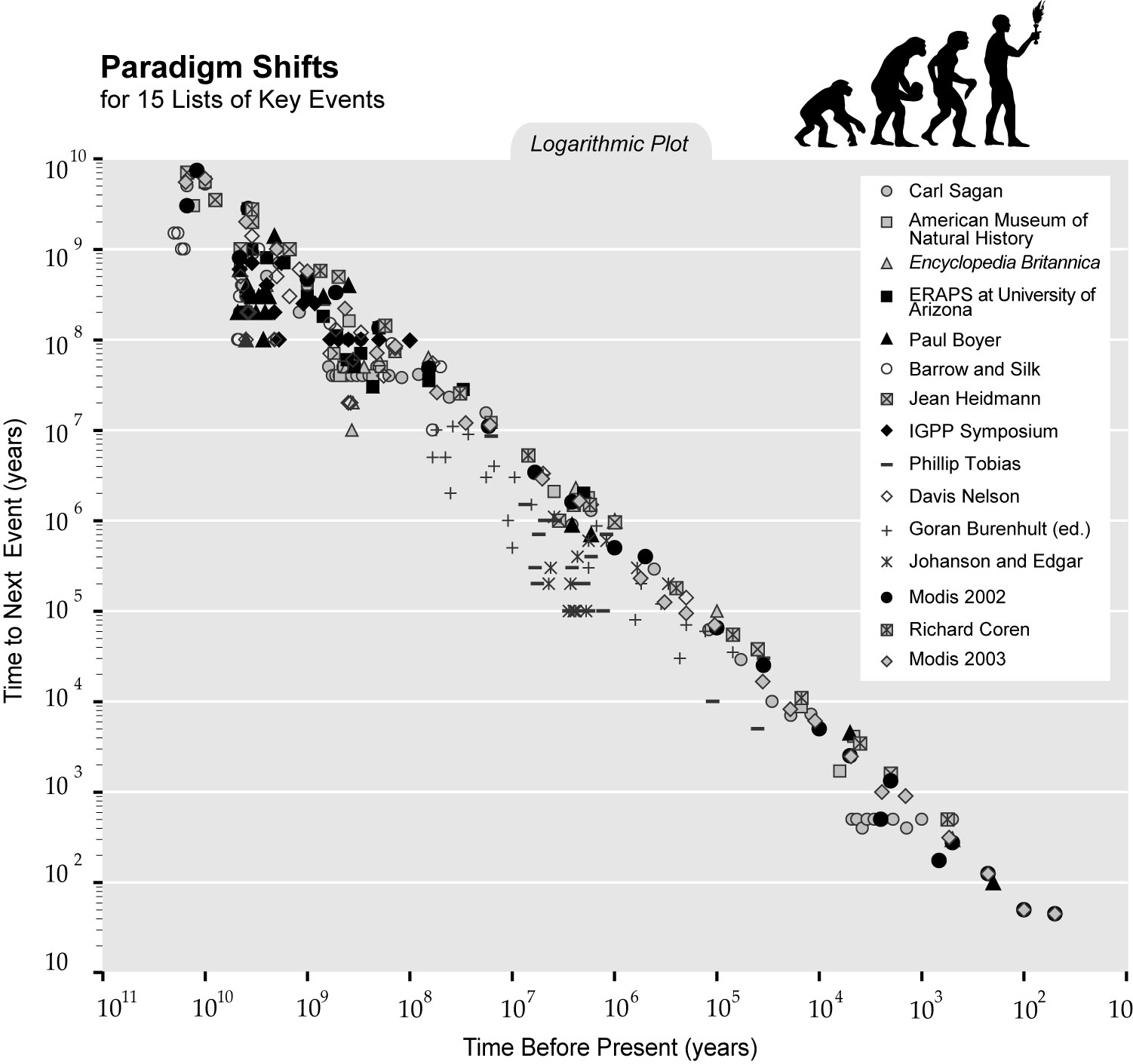
Paradigm Shifts for 15 Lists of Key Events,
Time to Next Event (Years), Logarithmic Plot, page 19
Source:
T.Modis,“Forecasting the Growth of Complexity and
Change,” Technological Forecasting and Social Change
69.4 (2002); http://ourworld.compuserve.com/homepages/tmodis/TedWEB.htm.
Carl Sagan, The Dragons of Eden: Speculations on the Evolution
of Human Intelligence
(New York: Ballantine Books, 1989). Exact dates provided
by Modis.
American Museum of Natural History. Exact dates provided
by Modis.
The data set “important events in the history of life”
in the Encyclopaedia Britannica.
Educational Resources in Astronomy and Planetary Science
(ERAPS), University of Arizona, http://web.archive.org/web/20040616074756/http:/ethel.as.arizona.edu/~collins/astro/subjects/evolve-26.html.
Paul D. Boyer, biochemist, winner of the 1997 Nobel Prize,
private communication. Exact dates provided by Modis.
J. D. Barrow and J. Silk, “The Structure of the Early
Universe,” Scientific American 242.4 (April 1980):
118–28.
J. Heidmann, Cosmic Odyssey: Observatoir de Paris, trans.
Simon Mitton (Cambridge, U.K.: Cambridge University Press,
1989).
J.W. Schopf, ed., Major Events in the History of Life, symposium
convened by the IGPP Center for the Study of Evolution and
the Origin of Life, 1991 (Boston: Jones and Bartlett, 1991).
Phillip Tobias,“Major Events in the History of Mankind,”
chap. 6 in Schopf, Major Events in the History of Life.
David Nelson, “Lecture on Molecular Evolution I,”
http://drnelson.utmem.edu/evolution.html,
and “Lecture Notes for Evolution II,” http://drnelson.utmem.edu/evolution2.html.
G. Burenhult, ed., The First Humans: Human Origins and History
to 10,000 BC (San Francisco: HarperSanFrancisco, 1993).
D. Johanson and B. Edgar, From Lucy to Language (New York:
Simon & Schuster, 1996).
R. Coren, The Evolutionary Trajectory: The Growth of Information
in the History and Future of Earth,World Futures General
Evolution Studies (Amsterdam: Gordon and Breach, 1998).
T.Modis,“Forecasting the Growth of Complexity and
Change,” Technological Forecasting and Social Change
69.4 (2002); http://ourworld.compuserve.com/homepages/tmodis/TedWEB.htm.
T. Modis, “The Limits of Complexity and Change,”
The Futurist [May–June 2003], http://ourworld.compuserve.com/homepages/tmodis/Futurist.pdf.
|